Deep dives6 min read
Are We Becoming More Connected or More Alone?
We can reach almost anyone, anywhere, at any time. So why, in the most connected era in human history, are so many of us still feeling alone?
hasaka sasaranga · 7 September 2026
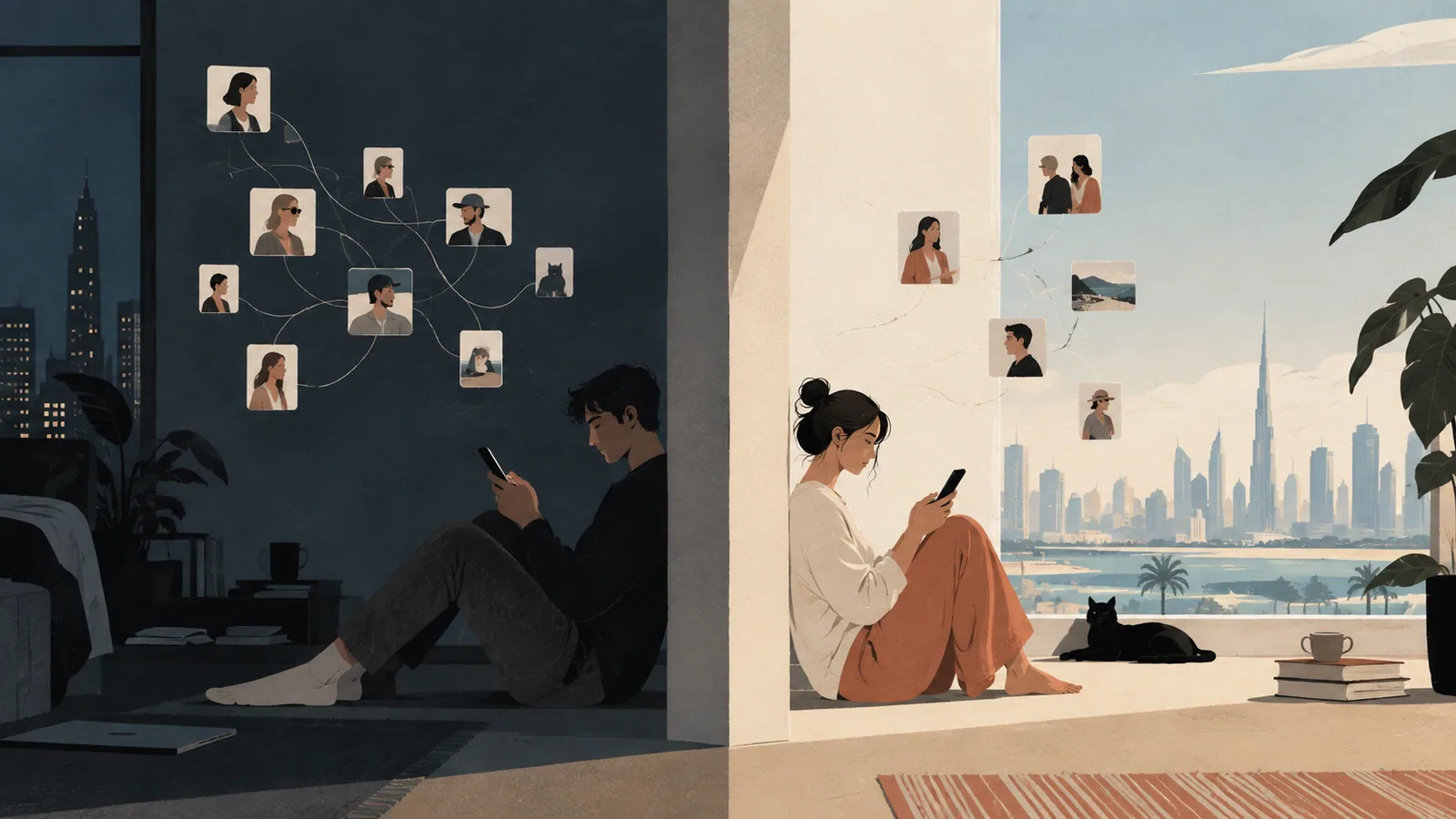
We have never been this connected.
A message can cross the world in seconds.
We wake up to notifications from friends, strangers, colleagues and people we haven't seen in years. We know what someone ate for breakfast, where they travelled last weekend and what song they are listening to right now.
Someone thousands of kilometres away can watch your life unfold almost in real time.
On paper, loneliness should be disappearing.
But something doesn't add up.
The World Health Organization estimates that roughly one in six people worldwide experience loneliness. Among young people, the numbers are even higher.
We built the largest communication network humanity has ever known.
Yet being able to reach someone is not necessarily the same thing as being close to them.
Maybe we didn't eliminate loneliness. We just made it harder to see.
Contact is not connection
Think about how many people you interact with during an ordinary day.
WhatsApp messages. Instagram stories. TikTok comments. Likes. Reactions. Emails. Group chats. Voice notes. Memes sent without a single word.
Hundreds of tiny interactions can happen before we go to sleep.
But how many of them become conversations?
How many people know when you're struggling without you posting about it?
How many could you call at 2 AM?
This distinction matters because social connection isn't simply about the number of people around us.
A person can have thousands of followers and feel lonely.
Another person can have three close friends and feel deeply connected.
The network became bigger.
That doesn't necessarily mean the relationships became deeper.
Friendship became measurable
For most of human history, friendship didn't have a number attached to it.
Then the internet gave us one.
Friends.
Followers.
Following.
Likes.
Views.
Subscribers.
Suddenly something deeply human could be displayed as a metric.
A person with 200 followers appeared less connected than someone with 200,000.
But the number tells us almost nothing about the relationship behind it.
We started accumulating connections in a way previous generations never could.
The strange part is that our brains may still be looking for something much older: trust, presence, familiarity and the feeling that someone genuinely knows us.
We know more people. Do we know them better?
There is another contradiction.
We may know more about people than any previous generation.
We know where they are.
What they're eating.
Who they're dating.
Where they're travelling.
What they're celebrating.
Sometimes we know these things about people we haven't spoken to in years.
That creates a peculiar form of familiarity.
You can watch someone's life every week without ever participating in it.
You know they got married because you saw the photographs.
You know they changed jobs because LinkedIn told you.
You know they're in Japan because Instagram showed you.
You know their life.
But do you still know them?
The disappearance of absence
There was once a natural distance between people.
When someone left the room, they were gone.
Friends moved away and you wondered what they were doing.
People travelled and returned with stories you hadn't already watched through their phone.
There was absence.
And absence created something else: anticipation.
Today, people rarely disappear completely.
They remain digitally present.
You may not speak to an old friend for five years and still know what their children look like.
We haven't necessarily maintained the friendship.
We've maintained access to information about the friendship.
Those are not the same thing.
But technology isn't the villain
It would be easy to blame all of this on social media.
That would also be wrong.
Technology has created forms of human connection that previous generations could barely imagine.
Families separated by continents can see each other every evening.
Someone who feels completely different from the people around them can find a community of people who understand them.
Long-distance friendships can survive.
People with disabilities, people living in isolated areas, migrants and countless others can maintain relationships that geography might otherwise make difficult.
Research increasingly suggests that digital technology itself isn't simply good or bad for loneliness. What matters is how it is used, why it is used and what kind of relationships it supports.
A video call with your mother isn't the same social experience as scrolling through strangers for three hours.
Both happen through a screen.
Only one may make you feel less alone.
Maybe the problem is substitution
Perhaps technology becomes dangerous to connection not when it connects us, but when one form of connection quietly begins replacing another.
A birthday message replaces the phone call.
The phone call replaces the visit.
The reaction replaces the message.
The like replaces the reaction.
Eventually, maintaining a relationship can require almost no interaction at all.
Tap a heart.
Relationship acknowledged.
Keep scrolling.
None of these behaviours are inherently meaningless. Sometimes a heart really does mean, "I'm thinking about you."
The question is what happens when the smallest possible signals of connection become substitutes for the deeper ones.
Alone together
There is a scene that would have looked strange only a few decades ago.
A restaurant table.
Four friends.
Four phones.
Nobody is technically alone.
Everyone is connected to hundreds of people.
And yet each person's attention can be somewhere else.
This may be one of the defining contradictions of modern connection.
We can be physically present and psychologically absent.
We can be alone while surrounded by people.
And we can feel deeply connected to someone who isn't physically anywhere near us.
The old boundaries between "alone" and "together" don't work as neatly anymore.
The numbers don't tell the whole story
There is evidence that loneliness is a serious global problem.
But even the research doesn't support the simplistic conclusion that smartphones created a lonely generation.
Loneliness is influenced by far more than screens.
Where we live matters.
Money matters.
Health matters.
Relationships matter.
Public spaces matter.
Work matters.
Major life changes matter.
Whether we feel supported matters.
And perhaps most importantly, the quality of our relationships matters.
That makes the problem much more uncomfortable.
Because deleting an app won't automatically rebuild a community.
The next stage of connection
And now another change is beginning.
Artificial intelligence is moving from being something we use to something we talk to.
AI can listen.
It can respond immediately.
It can remember preferences.
It doesn't get tired of hearing the same problem.
It doesn't cancel dinner.
It doesn't leave you on read.
For someone who is lonely, that can be genuinely comforting.
But it introduces a question we've barely begun to confront.
If something makes us feel understood, how important is it that there is another human being on the other side?
For thousands of years, conversation implied another consciousness.
That assumption is disappearing.
The next debate about loneliness may therefore go far beyond social media.
It may be about whether human beings require human connection at all.
So, are we becoming more connected or more alone?
Maybe both.
Technology has undeniably expanded our ability to communicate.
Distance matters less.
Communities can form across borders.
Relationships that once would have disappeared can continue indefinitely.
But connection has also become easier to imitate.
A notification can look like attention.
A follower can look like a friend.
Knowing what someone is doing can feel like knowing them.
Being visible can feel like being understood.
And perhaps that's the glitch.
We spent decades solving the problem of how to connect everyone.
We built satellites, smartphones, social networks, video calls and algorithms capable of placing billions of people within reach of one another.
We became extraordinarily good at eliminating distance.
But distance may never have been the real problem.
Because loneliness isn't simply the absence of people.
It's the absence of the connection we actually need.
And no number beside a profile picture can measure that.
Perhaps the real question isn't how many people we're connected to. It's how many people actually know us.