Reality check15 min read
You Have More Choices Than Ever. So Why Does Everything Look the Same?
Modern life gives us more freedom, opportunities and choices than any generation before us. Yet our careers, homes, travel, relationships and ideas of success increasingly look alike. Are we really choosing our own lives, or simply choosing from the same algorithmically approved options?
hasaka sasaranga · 10 September 2026
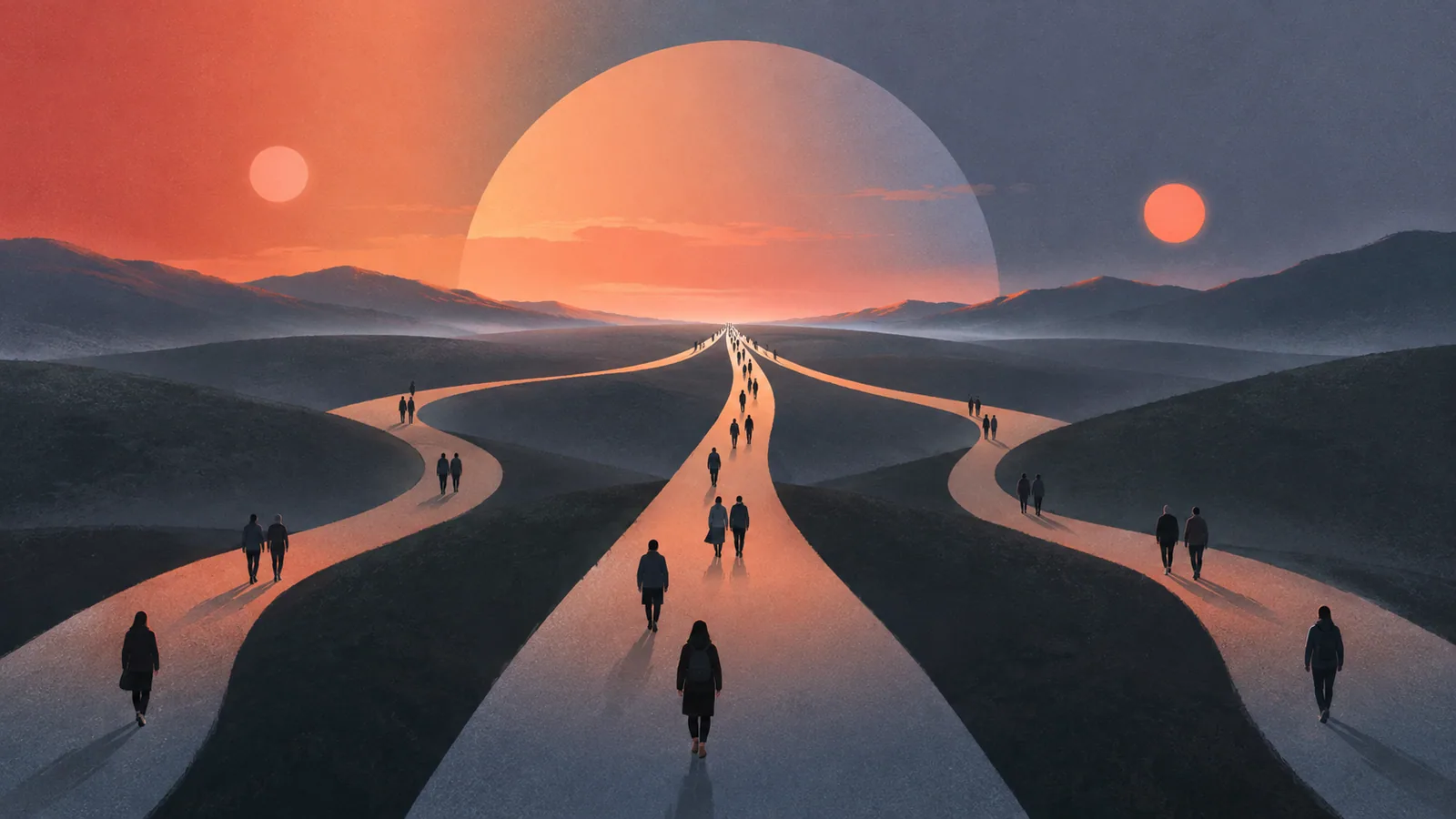
We have more choices than ever
Modern life is built around choice. We can choose where to live, what career to pursue, who to date, what to wear, what to believe, what to eat, what entertainment to consume and even what kind of person we want to become. Compared with previous generations, many of the barriers that once limited people's lives have weakened dramatically.
Geography used to determine much of your future. Your family, community and social class heavily influenced your profession, relationships and opportunities. Entertainment came from a limited number of television stations, newspapers and radio channels. Shopping meant choosing from whatever happened to be available locally. Meeting someone on the other side of the world was unusual. Reinventing yourself could require physically leaving everything behind.
Today, a person sitting in an apartment in Dubai can work for a company in another country, watch a documentary produced in Japan, learn from a university professor in the United States, order clothing from Europe, speak to someone in South America and build an audience spread across dozens of countries.
In theory, this should have produced one of the most diverse periods of human life imaginable.
Instead, something strange seems to be happening.
The more choices we have, the more similar many of our choices appear to become.
Open social media in Dubai, London, New York, Singapore, Sydney or Berlin and the details will be different, but the image of the desirable modern life can feel remarkably familiar. There is the stylish apartment, the carefully designed coffee shop, the gym routine, the airport photograph, the laptop on the table, the fashionable restaurant, the morning routine, the holiday destination, the successful career, the attractive relationship and the perfectly composed photograph proving that all of it happened.
Different countries. Different people. Different cultures.
Yet increasingly similar ideas about what a successful life is supposed to look like.
This creates one of the most interesting contradictions of modern life: we have more freedom of choice than ever, while simultaneously being exposed to more influence over those choices than any generation before us.
The important question may no longer be, "Am I free to choose?"
It may be, "How do I know whether the choice is actually mine?"
Choice overload is becoming part of modern life
Having more options sounds automatically positive, but human psychology does not always work that way. When there are only a few reasonable choices, making a decision can be relatively simple. When there are hundreds of possibilities, every decision creates dozens of alternative lives we could have chosen instead.
This is often described as choice overload. More options can create greater freedom, but they can also create decision fatigue, uncertainty and fear of making the wrong choice.
Choosing a career is a good example. Previous generations were often limited by geography, education and local industries. Modern workers can potentially become designers, developers, creators, entrepreneurs, consultants, remote workers, investors, freelancers, influencers or specialists in careers that barely existed twenty years ago.
That sounds liberating. It also means that whenever work becomes difficult, another possible life is visible.
Perhaps you should have started a business. Perhaps you should have stayed employed. Perhaps you should have moved abroad. Perhaps you should have chosen technology. Perhaps you should have pursued something creative. Perhaps you started too late. Perhaps you are wasting your potential.
The same pattern exists in relationships, travel, money and lifestyle choices.
Whatever life you choose, the internet can immediately show you someone who appears to have chosen better.
A person your age has already become wealthy. Someone else travels constantly. Another person has bought a home. Someone has started a successful company. Someone has left corporate life and appears happier. Someone has married and started a family. Someone else remained single and appears completely free.
Modern choice therefore carries an unusual psychological burden. We do not simply live our chosen life. We are constantly shown the lives we did not choose.
Social media has changed how we decide what is desirable
Human beings have always looked at one another to understand what is valuable. Social proof existed long before Instagram, TikTok or YouTube.
A busy restaurant attracts more customers because people assume the crowd knows something. Certain neighbourhoods become desirable because successful or fashionable people move there. Brands gain status because other people recognise their status. Careers become prestigious because society rewards the people who pursue them.
Social media massively increases the scale of this behaviour.
Instead of comparing ourselves with a relatively small community, we can now compare ourselves with millions of people.
Before breakfast, someone can see a 24-year-old entrepreneur celebrating a successful company, a couple travelling through Italy, an athlete showing an extraordinary physique, an influencer living inside a beautiful apartment, a former classmate announcing an engagement and a stranger explaining how they became financially independent before 30.
None of these people needs to be deliberately competing with us. Our brains still receive the same message: someone has more, someone is ahead and someone appears to have discovered a better version of life.
This is where social media influence becomes more complicated than simply advertising products. Platforms influence our perception of what a normal life looks like.
Luxury starts looking normal. Constant international travel starts looking normal. Extremely attractive bodies start looking normal. Exceptional career success at a young age starts looking normal. Perfect homes, relationships and lifestyles begin to appear ordinary because they are repeatedly placed in front of us.
Eventually, an ordinary but perfectly good life can begin to feel like failure.
Nothing about the life changed.
The reference point did.
Algorithms don't need to control us to influence us
When people discuss algorithms, the conversation often becomes dramatic. We imagine technology controlling our thoughts or manipulating society from behind a screen.
The reality can be much simpler.
An algorithm does not need to tell you what to choose. It only needs to influence what you repeatedly see.
What appears frequently begins to feel normal. What receives millions of views begins to seem culturally important. What receives admiration starts appearing desirable. What disappears from our feeds can gradually feel irrelevant.
Imagine entering a supermarket where the shelves constantly rearrange themselves. Products similar to things you previously purchased move to eye level. Products popular with people similar to you appear more frequently. Items you paused beside yesterday reappear today. Popular products receive more shelf space while unpopular ones slowly disappear.
You are still technically free to choose anything available.
But the environment around your decision is influencing where your attention goes.
Modern digital culture works in a similar way.
Algorithms increasingly determine which lifestyles, opinions, destinations, products, careers, relationships and versions of success enter our field of vision. They don't necessarily tell us what to want. They influence the menu from which our desires develop.
And because millions of people are being recommended similar high-performing ideas, millions of supposedly independent choices can begin moving in similar directions.
Why does everything look the same?
One of the internet's greatest promises was cultural diversity. Instead of everyone consuming the same television programmes, magazines and radio stations, people could discover millions of niche communities, creators and subcultures.
That happened.
But something else happened at the same time.
The world's aesthetics began converging.
Walk into a fashionable coffee shop in Dubai, Bali, London, Melbourne or Lisbon and you may immediately recognise the visual language. Neutral colours, polished concrete, natural wood, carefully placed plants, minimal typography, handmade-looking ceramics and interiors designed to photograph well.
Travel thousands of kilometres and sometimes you encounter what feels like the same café with a different name.
The same thing happens with fashion, interior design, photography, branding, fitness culture, travel and even architecture.
This is partly because everyone now has access to everyone else's references.
A successful restaurant concept in Copenhagen can inspire a restaurant in Dubai within months. A fashion aesthetic emerging in Seoul can spread globally through TikTok. A particular interior style can move from Pinterest boards to apartments around the world almost instantly.
We gained access to the entire world's creativity.
But the entire world also started looking at the same inspiration.
The result is a strange kind of global sameness.
Even individuality has developed a uniform
Modern culture places enormous value on individuality. We are constantly encouraged to be ourselves, reject expectations, follow our passions and build lives that feel authentic.
But even authenticity can become a trend.
There are now recognisable aesthetics for being a minimalist, entrepreneur, digital nomad, wellness enthusiast, creative professional, traveller or person who has supposedly rejected traditional success.
You can purchase the clothes associated with nonconformity. You can watch a tutorial explaining how to create an authentic morning routine. You can copy the productivity system of an independent thinker. You can follow influencers who teach you how to stop following everyone else.
Even rebellion can eventually become a template.
Consider the modern idea of escaping corporate life. The alternative once sounded radical: quit your job, move abroad, work remotely and build something independently.
Today, that alternative has its own visual language. Laptop. Tropical location. Coffee. Pool. Coworking space. Screenshot of revenue. Post explaining why the traditional nine-to-five life is broken.
This does not mean people living those lives are pretending. Many genuinely prefer them.
The interesting part is how quickly an alternative lifestyle can become another socially approved script.
Culture has an extraordinary ability to absorb rebellion and sell it back to us as a category.
We are no longer just living our lives. We are displaying them
One of the biggest differences between modern life and previous generations is the visibility of everyday experience.
A holiday is no longer only a holiday. It can become content.
A relationship is not only intimacy. It can communicate desirability and emotional success.
A home is not only somewhere to live. It can communicate taste.
A career is not only work. It can communicate intelligence, ambition and status.
Fitness is not only about health. It can communicate discipline.
Reading can communicate intellectual depth.
Even slowing down can become something publicly performed through posts explaining the importance of disconnecting.
None of this means people are consciously pretending. The change is subtler than that.
When experiences are visible to other people, they gain an additional function. They become signals.
And once an experience can signal status, taste, success or happiness, the signal itself can begin influencing which experiences we choose.
The question slowly changes from "What would make me happy?" to "What does a happy life look like?"
Those questions can produce very different answers.
We may be experiencing our lives through imagined audiences
Think about travelling somewhere famous today.
There is a good chance you have already seen the destination hundreds of times before arriving.
You know the famous viewpoint. You recognise the restaurant. You know which angle people photograph. You know where the sunset picture is taken. You may even know what pose people use.
Sometimes we arrive carrying a pre-existing image of how the experience is supposed to look.
Instead of discovering the place, we recreate the photograph.
This behaviour extends far beyond travel.
People increasingly understand parts of their lives through how those experiences could appear to others. The wedding, birthday, restaurant, new home, car, fitness transformation and career announcement all have potential public versions.
This creates an invisible audience that can follow us even when nobody is physically watching.
Parents, friends, former classmates, colleagues, strangers, ex-partners and people we barely know can become imaginary spectators.
Sometimes we make decisions partly for people who may not even be paying attention.
Look where I live now. Look what I achieved. Look how successful I became. Look how happy I am. Look who I became.
It is possible to spend years winning an argument nobody else knows is happening.
Status didn't disappear. It became harder to recognise
Traditional status symbols were obvious: expensive cars, large houses, designer clothing, luxury watches and exclusive memberships.
Modern status can be more subtle.
Status can look like freedom.
It can look like having enough money not to care about money.
It can look like minimalism, wellness, cultural awareness, unusual travel destinations, knowing a restaurant before it becomes popular or living in a neighbourhood before everyone else discovers it.
Sometimes owning fewer things becomes a status symbol.
Sometimes appearing uninterested in status becomes a form of status itself.
This matters because people often believe that rejecting traditional consumerism automatically makes their decisions more independent.
Not necessarily.
Human beings can build hierarchies around almost anything.
The object changes.
The comparison remains.
Personalisation can trap us inside previous versions of ourselves
Modern platforms promise personalisation. Spotify learns the music we like. YouTube learns what we watch. TikTok learns what holds our attention. Online stores learn what we buy. Professional networks learn what work interests us.
At first this feels useful.
But personalisation creates an interesting feedback loop.
The system observes what you previously liked and recommends similar things. You consume those recommendations, giving the system stronger evidence that its understanding of you is correct. It then recommends even more of the same.
Gradually, you can become surrounded by increasingly refined versions of your existing preferences.
The system learns who you are based on what you have done.
Then it helps determine what you encounter next.
In an unexpected way, extreme personalisation can sometimes make reinvention more difficult.
You may think you are exploring the world while repeatedly being shown a version of the world designed around your past behaviour.
Having options is not the same as having agency
This distinction may be one of the most important ideas in understanding modern life.
Options exist outside us.
Agency exists inside us.
Having twenty possible careers means you have options. Understanding why one of those careers matters to you requires agency.
Being able to travel almost anywhere gives you options. Knowing whether travel genuinely makes you happy requires agency.
Having access to thousands of clothing styles gives you options. Knowing what you like when nobody is watching requires agency.
Modern society has become exceptionally good at producing options.
It is much less effective at teaching us how to decide which options actually belong in our lives.
That ability requires reflection, and reflection requires something increasingly rare: psychological silence.
We need enough distance from advertisements, recommendations, comparison, expectations, opinions and constant content to hear our own reactions.
Ask yourself a few uncomfortable questions. What would you enjoy if you could never post it? Where would you travel if nobody knew you had gone? What career would you pursue if job titles carried no status? What would you wear if nobody could judge it? What would you learn even if you remained mediocre? What would you build if nobody applauded for five years?
The purpose isn't to reject everything influenced by other people.
Influence is unavoidable.
The purpose is to notice which desires remain when the audience disappears.
The ordinary life may be becoming the radical choice
Modern culture constantly tells us to make our lives exceptional.
Build something. Scale something. Travel somewhere. Optimise yourself. Become financially independent. Develop a personal brand. Monetise your hobbies. Improve your body. Upgrade your home. Expand your network. Turn your expertise into content.
Almost everything can become a project.
But perhaps one of the most unconventional decisions in modern life is deciding that something is simply enough.
A job that pays enough but doesn't impress strangers. A relationship that isn't publicly performed. A comfortable home that won't appear in an architecture magazine. A small circle of friends. A hobby that never becomes a business. A holiday with very few photographs. A weekend in which absolutely nothing worth posting happens.
From the outside, this kind of life may appear ordinary.
From the inside, it may be deeply successful.
Digital platforms struggle to measure this kind of happiness because there may be no visible evidence of it.
No follower count.
No revenue screenshot.
No transformation photograph.
No viral announcement.
No public scoreboard.
Perhaps some of the most meaningful parts of human life were never meant to produce metrics.
Following the crowd is not always wrong
There is an easy mistake to make when discussing conformity. We can start believing that popular choices are automatically shallow and unusual choices are automatically intelligent.
That would simply create another form of conformity.
Sometimes something is popular because it is genuinely good.
Millions of people enjoy beaches because beaches can be beautiful. People pursue financial stability because financial instability is stressful. People want loving relationships because connection matters. People visit famous cities because famous cities often contain extraordinary things.
Rejecting something purely because other people like it is not independence.
Contrarianism still allows the crowd to determine your behaviour.
If everyone walks left and you automatically walk right because you refuse to follow them, the crowd still decided your direction.
Real individuality is less dramatic.
Sometimes you go left.
Sometimes you go right.
Sometimes you follow everyone else because they discovered something worthwhile.
And sometimes you walk away completely.
The difference is understanding why.
The goal isn't to create a completely original life
Nobody creates themselves from nothing.
Our language came from other people. Our values were influenced by families and cultures. Our understanding of relationships came partly from watching other relationships. Our ambitions are shaped by what we have seen others achieve.
We are social creatures.
A completely uninfluenced life is probably impossible.
The goal therefore isn't originality.
It is awareness.
There is a major difference between unconsciously wanting something because everyone around you wants it and saying, "I understand where this desire came from, and I still choose it."
You can choose the popular career.
Move to the popular city.
Buy the fashionable furniture.
Get married.
Stay single.
Start a business.
Keep a stable job.
Travel constantly.
Never travel.
Own expensive things.
Own almost nothing.
None of those decisions proves whether someone is independent.
The better question is whether the life fits the person actually living it.
Freedom may eventually require fewer choices
We usually imagine freedom as addition.
More money. More opportunities. More connections. More destinations. More information. More options.
But there may be a point where freedom starts requiring subtraction.
Fewer comparisons. Fewer opinions. Fewer people whose approval matters. Fewer metrics used to evaluate yourself. Fewer identities you feel obligated to maintain. Fewer ambitions inherited from strangers.
Not because the world offers too much.
Because one human life cannot contain everything the world offers.
Time is limited.
Attention is limited.
Energy is limited.
Eventually, choosing a life means refusing thousands of alternative lives.
That is uncomfortable because modern culture constantly teaches us to keep our options open.
But a life permanently kept open is never fully lived.
At some point, you have to choose.
So why does everything look the same?
Perhaps because having access to millions of possibilities doesn't automatically make us individual.
We may have more choices than ever, but we are also watching one another more than ever. We are exposed to the same viral trends, the same success stories, the same rankings, the same influencers, the same aesthetics and increasingly similar algorithmic recommendations.
Nobody needs to force millions of people toward the same definition of happiness.
We can do it ourselves.
One person imitates another person who was inspired by someone else, and eventually a cultural pattern emerges that nobody consciously designed.
That doesn't mean freedom is an illusion.
It means freedom requires more than access to choices.
It requires enough self-awareness to recognise why we are choosing them.
Perhaps the most important question in modern life isn't whether we have enough options.
We clearly do.
The question is whether we can still hear ourselves among them.
The next time you find yourself desperately wanting the career, apartment, relationship, destination, lifestyle or version of success everyone seems to be chasing, ask one simple question:
Would I still want this if nobody could ever know I had it?
If the answer is yes, keep going.
Maybe that choice really is yours.